Saturday, April 12, 2008

Happy Yuri's Night 2008
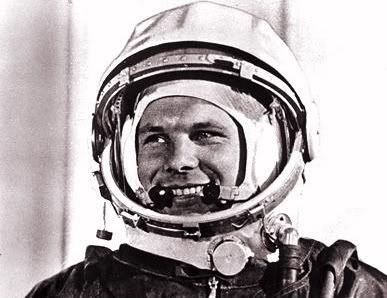

Tonight is Yuri's Night, the 47th anniversary of the first manned spaceflight. On April 12, 1961, Yuri Gagarin rode the Vostok 1 rocket into history, and in recent years Yuri's Day and Yuri's Night has become an international holiday, much like St. Patrick's Day. You can learn more at this web site: Yuri's Night. I have a bottle of some fine sangria wine that I intend to sample, and raise a toast for the occasion.

And another famous cosmonaut, or cosmopooch, is in the news today:

AP - MOSCOW - Russian officials unveiled a monument to Laika, a dog whose flight to space more than 50 years ago paved the way for human space missions. The small monument is near a military research facility in Moscow that prepared Laika's flight to space on Nov. 3, 1957. It features a dog standing on top of a rocket.

I wish everyone a happy and safe Yuri's Night.


VIKTOR KUPRIN


Technorati tags: , , , , , ,

Labels: , , , ,

Thursday, February 28, 2008

Svatohor from Long Ago and Far Away

From 1989 to 1993, the Public Broadcasting Service (PBS) featured a delightful program of animated fairy tales, legends, and folkloric stories from around the world: Long Ago & Far Away. It was hosted by James Earl Jones. Yes, that James Earl Jones, famous as the voice of Darth Vader and for playing the role of Conan the Barbarian's arch-nemesis, Thulsa Doom. My daughter, Holly, and I loved the series, and always watched it every Sunday morning.

My favorite episode was this stop-motion animated Russian tale of Svatohor (Saint Mountain), a brave hunter who faced impossible tasks and the evil dragon-like creature Gorym Gorynet. Here, courtesy of YouTube, is that original feature in three parts.

I wish this series would be released as a DVD set. It would be a hot seller. Enjoy.


And here's a Snickers candybar commercial that parodies my favorite Russian fantasy movie, Ilya Muromets (The Sword and the Dragon). Though Zmey Gorynych, the three-headed dragon, doesn't actually appear in it, Ilya is there in all his Slavic glory.


Viktor Kuprin

Technorati tags: , , , , , ,

Labels: , , , , , ,

Tuesday, January 01, 2008

I Saw Ded Moroz on New Year's Eve!

Yes, I saw Dedushka Moroz, Grandfather Frost, on New Year's Eve! I had stepped out of my condo's back door to place a couple of bottles of bubbly on my patio to chill in the cold winter air. It had just gotten dark, and the edge of a cold front had arrived, soon to bring flurries of snow. I looked up and saw an amazing sight. The clouds had formed a perfect image of Ded Moroz, his big fluffy beard, nose and cheeks filling the eastern sky in perfect symmetry. And the timing was just about right because he had finished delivering gifts to all the boys and girls in Armenia, Russia, and other Eastern countries, and was by now headed West. There was no sign of Snegoruchka, the Snow Maiden. My own Snow Maiden waited for me inside: my wife, Irina. The magical visage of Ded Moroz lasted but a few minutes, then blew away as snow clouds began to cover south-central Indiana, and in the morning the snow would almost cover the ground. It was a magical experience, and a fitting end to the old year. Today we will celebrate with a New Year's feast, in the Armenian tradition of opening our home to guests on January 1st. I hope old Ded Moroz passed over your house, too. Happy New Year, S'Novim Godim!

Viktor Kuprin

Technorati tags: , , , , , , , ,

Labels: , , , , , , , ,

Monday, December 31, 2007

The Story of Ded Moroz, Grandfather Frost, the Russian Santa Claus


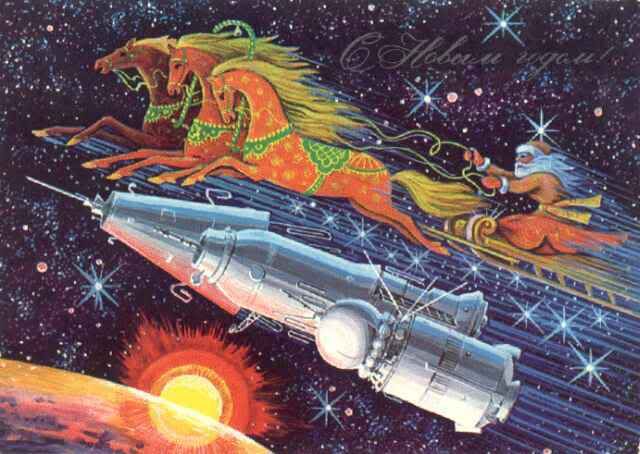
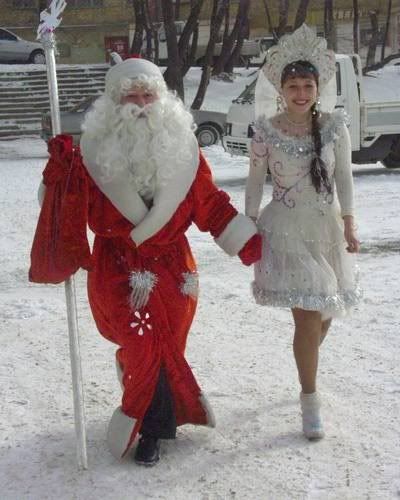
In Russia, Armenia, and other Eastern European countries, the holiday season heralds the arrival of Dedushka Moroz, “Grandfather Frost”, their version of Santa Claus. He looks a lot like the St. Nick that we know in the West, but he’s kind of different, too. He’s a bit thinner, and sometimes he wears blue coats, not just red ones. It is said that Joseph Stalin once ordered that Ded Moroz should always wear blue so as not to be confused with Santa Claus! Ded Moroz's home is deep in the forests “beyond Findlandia and Lapland”, and he rides in a troika sleigh pulled by three horses, not reindeer. The official residence of Ded Moroz in Russia is the town of Veliky Ustyug. The old fellow can get downright grumpy sometimes when children behave badly, but he brings presents to kids even if they’re good only right before New Year’s. That’s right, New Year's. In the East, they put up the yolka, the decorated evergreen tree for New Year’s since the more-quietly celebrated Orthodox Christmas falls on January 7, not December 25. But yolka trees often have a big red star on top, just like the ones on top of the Kremlin!

Another big difference between Ded Moroz and Santa Claus is that Grandfather Frost is a single guy. There’s no dowdy Mrs. Claus waiting for him back at the toy shop. Ded Moroz is often accompanied by Snegoruchka, the beautiful Snowmaiden who was made from snow by a lonely old Russian couple to live as their daughter. Sadly, she melts away every spring but returns each winter much to everyone’s delight. Legend has it that Snegoruchka is Ded Moroz’s granddaughter, but many people, me included, have doubts. She often wears some short-short white fur-lined dresses, and there may be some hanky-panky going on between her and old Ded Moroz. But then again, it gets pretty cold at night in Siberia!
S'Novim Godim, Happy New Year, to you all!

Viktor Kuprin

Technorati tags: , , , , , , , ,

Labels: , , , , , , , , ,

Tuesday, November 20, 2007

Ptushko's Ilya Muromets -
The Sword and The Dragon

In 1960 my great-aunt Ethie passed away, and my grandparents had the sad duty as executors of her estate. My grandmother, Ollie Marie George, and her sisters all had old fashioned names which you don't hear much anymore: Ethie, Novie, and Ollie, my "Mamaw". I was five years old, barely big enough to understand why we were going to Bedford, Indiana, where Aunt Ethie's home was located. Bedford and its surrounding towns are famous for their limestone quarries. The Empire State Building, The Pentagon, and many other famous buildings were built with Indiana limestone.

During one of the trips to Bedford, we stopped at a newly opened IGA "Foodliner" supermarket. I think my grandparents, so used to shopping at small general stores, were somewhat intimidated by the long, confusing rows of products and the bright fluorescent lights. At the front of the store was a comic book rack, a treasure before my eyes. My family used a sly but effective technique of allowing me to pick out one comic book during any trips to town, and encouraged me to choose carefully. In that way I was headed off from begging for whatever outlandish toy I might find. As a result, I began reading at an early age, and as time went by, I accumulated a substantial comic book collection. And I still have many of those comics to this day.

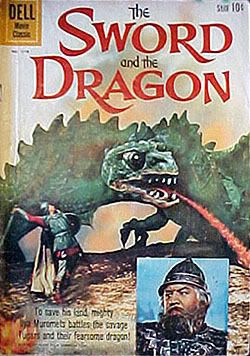
As I scanned the comic book covers, one immediately caught my eye: A huge, hideous fire-breathing dragon and a hefty guy in armor getting ready to have at it! The issue that I chose that fine day was the comic book version of the film The Sword and The Dragon. Many, many years later I would learn that the movie was Russian, originally titled Ilya Muromets, directed by the Soviet Ray Harryhausen, Alexandr Ptushko.

Recently I had the pleasure of seeing the original film on DVD, beautifully restored by Russia's Rusico film company, along with other Ptushko classics such as Ruslan and Ludmilla, Sadko, and The Tale of Tsar Sultan. I'm still waiting for Sampo, known in the West as The Day The Earth Froze, based on the Finnish Kalevala saga.

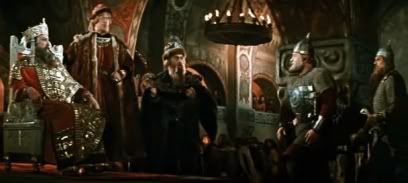
Released in the Soviet Union in 1956, Ilya Muromets is based on a well-known Russian folktale about a paralyzed hero (Ilya) who regains his strength to do battle against the invading Tugar tribe of vicious Tartars. He encounters a hurricane-breath demon (Nightingale), treacherous boyars, and, in the grand finale, the terrible three-headed dragon, Gorynich, which may have inspired Ishiro Honda and Tomoyuki Tanaka when they later introduced King Ghidorah in their Godzilla films.


Ilya Muromets is an amazing film, my favorite of all Ptushko's work. He must have had the entire Red Army in use as extras during its production because its publicity information claims "A Cast of 106,000! 11,000 Horses!" The scenes of the massive Tugar army on the move are astounding. It is noteworthy too as being the first USSR film made in "SovietScope", actually Dyaliscope, the French version of Cinemascope, and it was the first Soviet film to have a stereo soundtrack.

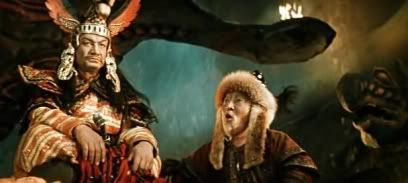
Some of the best scenes in the movie come from the villains, the Tugars, especially their chief, Tsar Talin. Played by Uzbekistan's veteran stage and film actor Shukur Burkhanov, the ruthless Talin grins and leers as he gleefully declares, "I'm going to attack ... KIEV!" Burkhanov started acting in the 1920's but had to leave his family to be able to become an actor. The strict Islamic law practiced in his home region forbid one person from imitating another. Trained at the Moscow Art Theater and in the Stanislavsky School of Acting, his delightful performance as the evil Tartar in Ilya Muromets is in total contrast to the stodgy, serious Russian hero, Ilya, played by Boris Andreyev.


Epic films such as Ilya Muromets can now only be made via computer graphics. And I suspect it would have been impossible to finance such a movie in the West even during the 1950s. Only the cost-blind Soviet system could have produced such a spectacle. Let's hope that Rusico will continue to restore and release more classic films. Spasiba Rusico!


Gorynich The Dragon Attacks Kiev


Technorati tags: , , , , , ,

Labels: , , , ,

Friday, November 09, 2007

New Russian SF Film in production: Strugatskys' The Inhabited Island

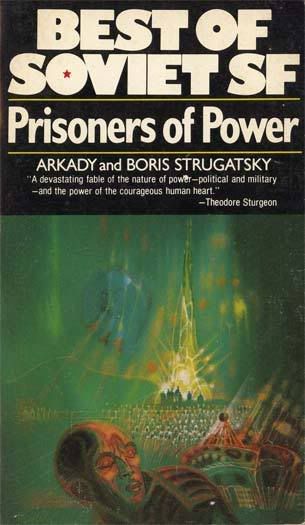
The global success of Russia's Nightwatch and Daywatch films may be leading to a renaissance of fantasy/science-fiction movie projects in that country. Now being filmed in Russia, Arkady and Boris Strugatsky's The Inhabited Island, a.k.a. Prisoners of Power, scheduled for release in January 2009.


From the Wiki:

Prisoners of Power also known as Inhabited Island (Russian: Обитаемый остров, IPA:[obɪ'taʲemɨj 'ostrof]) is a science fiction novel written by Soviet authors Arkady and Boris Strugatsky. It was written in 1969 and originally published in 1971, the English translation was released in 1977. The protagonist is a young adventurer from Earth — Maxim Kammerer who gets stranded on an unknown planet Saraksh.

The story describes the adventures of Maxim Kammerer. Kammerer is an amateur space explorer from Earth. This occupation is not considered serious and Kamerer is regarded as a failure by his friends and relatives. The novel starts when Kammerer accidentally discovers an unexplored planet Saraksh inhabited by a humanoid race. The level of technological development on the planet is similar to mid-20-eith century Earth. Recently, the planet had a nuclear and conventional war and the predicament of the population is dire. When Kammerer lands, the natives mistake his spaceship for a weapon and destroy it.

At first, Kammerer does not take his situation seriously. He imagines himself a Robinson Crusoe stranded on an island inhabited by primitive but friendly natives. He is looking forward to establishing contact and befriending the population of the planet. However, the reality turns out to be far from glamorous. Kammerer finds himself in the capital of a totalitarian state, perpetually at war with its neighbors. The population is governed by the oligarchy of Unknown Fathers through brutal police and military repression. The city is grim and polluted. Ordinary populace leads the life of privation and misery. What goes on around Kammerer does not make sense to him, since his own society is free from war, crime and material shortages.

Eventually, it is revealed that to maintain the loyalty of the population, the Fathers employ mind control broadcasts. The broadcast towers pepper the landscape of the country. The mind-altering capabilities of the towers are kept secret, they are disguised as ballistic missile defense installations. Constant broadcasts suppress the ability to evaluate information critically, hence making the omnipresent regime propaganda much more effective. In addition, twice a day, intense broadcasts relieve mental stress caused by the disconnect between the propaganda and the observed reality by inducing an outburst of blinding enthusiasm.


Technorati tags: , , , ,

Labels: , , , , ,

Wednesday, November 07, 2007

Soviet Animation - Fantadrom 2 and Nu Pogodi! - You Just Wait! I'll Get You!

What's an alien to do when it needs to borrow a pinch of salt?

The answer is in Fantadrom episode 2, a classic Soviet-era science-fiction animation from the early 80s. The first episode is also viewable in my earlier blog posting.

You might notice that in the film text is sometimes displayed in Russian Cyrillic and in Latin script. The English-like letters are Latvian; Fantadrom was created in a Riga animation studio. Nonetheless, Russian was the language most often spoken in public and used for business in the USSR, and spoken dialogue is always Russian.

The Internet has certainly promoted the study of English in Armenia, where I used to live, and in other former-Soviet countries, but Russian is still taught in Armenian schools, and no responsible parent would ever allow their children not to learn it.

Like so many Soviet-era cartoons, Fantadrom is playful, silly, and sometimes very surreal. Many Soviet animators were greatly influenced by the Beatles' animated film The Yellow Submarine as well as the psychedelic artwork of Peter Max.


Fantadrom 2


Nu Pogodi!

And here is a sample of the much more rough-and-tumble Nu Pogodi (You Just Wait, I'll Get You!), with the scruffy, cigarette-smoking wolf always after the cute, innocent hare. Like all good villains, the wolf is by far more interesting than his victim, and you can get some good glimpses of daily Soviet life from these cartoons, like the electric trolley-buses. A ride on one still costs 5 cents in Yerevan, Armenia! And there's the huge escalators leading to the metro, the subway. There are no "undergrounds" here in Indiana, and it was so convenient and fun to ride them in Yerevan. The price of a subway token: yes, 5 cents!


Notice, too, the scene where the wolf shows his empty pockets to the passing militsia cops, to avoid being shaken down for a bribe. Americans have no concept of how corrupt law-enforcement officers demand money from innocent citizens, but it happens every day in the former USSR.

And be warned: The lalala-lala Nu Pogodi main theme song will stick in your brain for the rest of the day. I caught myself singing it in the shower this morning!


Do S'Vadaniya,

Viktor Kuprin

Technorati tags: , , , , , , , , , , ,

Labels: , , , , ,

Monday, November 05, 2007

Violence, Kids, and Soviet Animation

From today's news:

Screen violence tied to boys' aggression: study

By Andrew Stern

CHICAGO (Reuters) - Boys aged 2 to 5 who viewed an hour of on-screen violence a day increased their chances of being overly aggressive later in childhood, but the association was not seen in girls, researchers said on Monday.

"This new study provides further evidence of how important and powerful television and media are as young children develop," study author Dr. Dimitri Christakis of Seattle Children's Hospital Research Institute said.

"Of 184 boys (in the study), 25 of them had serious problems with aggression and for each hour on average per day they had watched violent TV, they were three times more likely to be in that group" than those who did not watch violent programming, Christakis said in a telephone interview.


While living in Armenia, I got to see many Soviet-era animated programs, some of excellent quality. This was a direct result of the communist-era laws that compelled film and television studios to devote a percentage of their production for children's programming. One noticeable difference between their cartoons and those produced in the West was the lower level of violence. Sure, the Russians loved their Nu Pogodi (I"ll Get You) antics of the Wolf and Hare, the USSR equivalent of Tom and Jerry, but most of the made-in-the-USSR toons were gentler and, perhaps, a bit kinder than the cartoons I watched growing up in the USA.

And because I watched and loved seeing Popeye knock the bejeesus out of Bluto on a daily basis, not to mention the Three Stooges every Saturday morning, I have mixed feelings about the Reuters story above. I like to think those shows didn't warp my young mind and, so far, I've never had the urge to actually go postal and do anyone real harm, except perhaps sometimes in my strange-but-harmless imagination.


I once read that the Japanese consider Tom and Jerry style cartoon violence to be much more disturbing and harmful to children because it is so fake. If you've ever seen Japanese anime, you know that when a person gets shot, there are consequences. It is shown to be painful, there is blood and injury that doesn't disappear in the next scene. Not so when Jerry whacks Tom with an anvil or frying pan. Tom's head pops back into normal shape and the chase continues.

My five-year-old son, Ron Armen, loves to watch the Power Rangers and Transformers, though his watching time is strictly rationed by Irina, his mom, more for consideration of his eyesight than the programs' content. I know he acts out the martial arts moves that his favorite TV characters do on screen, but he doesn't use those moves to whup the five-year-old neighbor kid down the block. I am very skeptical, too, of studies like Dr. Christakis has done because I know that statistics can be presented to emphasize a politically-correct agenda and thus please the sponsoring parties involved. I think that out of nearly 200 American boys, for 25 of them to have problems with violent behavior is not that surprising, sad but true. It's just hard for me to believe that most of the blame can be directed towards television programs.

And back in Armenia, kids now get to watch imported Tom and Jerry cartoons, including all the flying anvils, crushing boulders, and face-flattening frying pans. Their lack of spoken dialogue makes them great exports to non-English speaking countries like the former USSR.

Here's a wonderful example of some Soviet-era animation, and it's a science-fiction piece, too. I love the Cosmic Cat!

Do S'Vadaniya,

Captain Kosmos


Fantadrom One


Technorati tags: ,, , , , , , , ,

Labels: , , , , , , , , , , ,

Tuesday, October 30, 2007

A Trick or Treat Goody: Godzilla Attacks Russia


Here's a Halloween treat, the Austin Wind Symphony playing a medley from the soundtrack of King Kong vs. Godzilla. Yes, Captain Kosmos is a fan of the Big G, but also a fan of the late Akira Ifukube, the great Japanese composer who scored so many of Japan's classic films, including Toho Studio's kaiju giant-monster movies. King Kong vs. Godzilla had most of its original soundtrack replaced by stock Universal Studios' horror-film music when it was exported to the West, so it was a special choice by the concert organizers to showcase this particular Godzilla movie.

Godzilla's appearance gradually changed from one movie to another, but this one is one of my favorites: a huge, bulky rock-iguana style head and humongous, powerful, almost-Sumo-like legs.

Not many Americans may notice, but Godzilla's first battle in the film occurs on Russian soil! The army base he attacks is on Sakhalin Island, just north of Japan, and, unfortunately for the Red Army, he's not in a good mood after being buried in ice for seven years, after the events of Godzilla Raids Again, a.k.a. Gigantis the Fire Monster. His radioactive breath, crushing feet, and swinging tail make short work of the Stalin tanks sent out against him. If you watch the film, look closely and you can see red stars on the tanks as they roll out from the base to fight Godzilla.

So, enjoy this giant monster treat from the Austin Wind Symphony. I only wish they would play my favorite Toho science-fiction film soundtrack sometime in the future: The Mysterians.


Technorati tags: , , , , , , , ,

Labels: , , , , , ,