Sunday, November 09, 2008

WindyCon, Building a Military SF Library, and Freehold

Next weekend I will be attending the WindyCon 35 science-fiction convention in Chicago. The event’s theme is military science fiction, and Baen Books’ John Ringo is the guest of honor, along with author Eric Flint, Star Trek’s and Babylon 5’s Walter Koenig, and artist David Mattingly.



I’m a Cold War veteran, and I spent most of my hitch in the Strategic Air Command’s 22nd Heavy Bomber Wing. And like most veterans, I learned pretty quickly that the old adage that advises “Don’t volunteer for anything!” is essential unless you want to subject yourself to dreadful humiliation or great risk. So, when I logged on the WindyCon site to make some suggestions for panel discussion topics, I had no idea that I was, in fact, volunteering to be a panel member. But that’s what happened, and I’ll be participating in the panel about Building a Military SF Library - What are the great books of military SF? What does any aspiring military SF writer need to have in a reference collection? Panelists tell you.
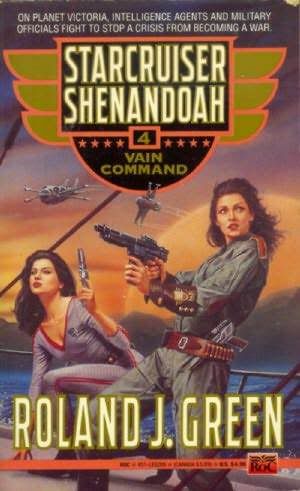
The session is scheduled for Saturday at 7 p.m., Nov. 15, in Ballroom C (C6, to be exact). While it’s a totally unexpected privilege for me, and my first time to be on a convention panel, I’m very honored and happy that Roland J. Green, the author of some of my all-time favorite military science-fiction series (Starcruiser Shenandoah, The Peacekeepers) will also be a panel participant.

On Friday evening I don’t want to miss the panel discussion titled Liberal Military SF: Does It Exist? - Can a writer be a liberal and a military SF writer? Is there something in military SF that requires a conservative outlook? Not counting the revolutionaries, are there any good portrayals of liberals in the genre?

Somehow I’m not surprised that Michael “Mad Mike” Z. Williamson will be a panelist on that one. Mad Mike almost got me in trouble in 2005 while I was living in Armenia. I was enjoying myself in an Internet café in the capitol city of Yerevan and, thanks to the Baen Free Library, I came across Williamson’s first novel, Freehold. To be generous I will just say that I didn’t like it much. The libertarian paradise it portrayed was as unbelievable to me as any Soviet propaganda about a future world of “pure communism”. But that’s not what almost got me into an unpleasant situation. The adult content in Freehold did. In fact, I think Williamson went way, way beyond erotica and crossed the line into pornography with his detailed descriptions of lesbian and group sex acts by the novel’s characters.

And, in Armenia, possessing, reading, and downloading pornography can get you into big, big trouble. Trouble like the interior of an old Soviet prison cell. And, quite frankly, I didn’t expect content like that when I started reading the story. Baen’s other online stories contain nothing like what I saw in Williamson’s book.

Lucky for me, the Internet café proprietors and their up-stream service providers didn’t detect the lewd text and, yes, they do monitor and sometimes block adult content in Armenia and in many of the other post-Soviet Republics. No militsia thugs wearing big CCCP service caps appeared to beat me up, extort money, or haul me to KGB headquarters. But it did put me off of reading any more of Williamson’s books. I’ve seen his comments that say “It was my first novel. I’ve learned a lot since then,” but, on his own website, his response to the subject of the controversial sexual content in Freehold is pretty flip.

I got a bad feeling, too, about such sexually explicit content being available on Baen’s online library with no warning, no disclaimer, no parental advisory, and, as a parent, that gives me the creeps.

Earlier this year, at Dayton’s Marcon sf convention, I told Baen publisher Toni Weisskopf about my experience in Armenia and my concerns. She urged me to give Mad Mike another try, to read some of his later work, but first impressions are lasting ones. And I have too many good books from other authors on my to-read list, thank you all the same.

Until next time, D’os Vadanya,

VIKTOR KUPRIN

Labels: , , , , , ,

Saturday, April 12, 2008

Happy Yuri's Night 2008


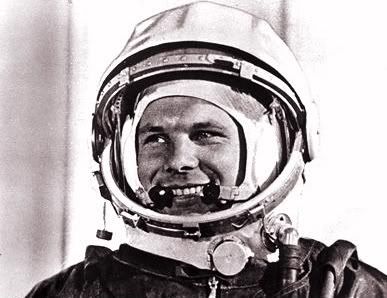
Tonight is Yuri's Night, the 47th anniversary of the first manned spaceflight. On April 12, 1961, Yuri Gagarin rode the Vostok 1 rocket into history, and in recent years Yuri's Day and Yuri's Night has become an international holiday, much like St. Patrick's Day. You can learn more at this web site: Yuri's Night. I have a bottle of some fine sangria wine that I intend to sample, and raise a toast for the occasion.

And another famous cosmonaut, or cosmopooch, is in the news today:

AP - MOSCOW - Russian officials unveiled a monument to Laika, a dog whose flight to space more than 50 years ago paved the way for human space missions. The small monument is near a military research facility in Moscow that prepared Laika's flight to space on Nov. 3, 1957. It features a dog standing on top of a rocket.

I wish everyone a happy and safe Yuri's Night.


VIKTOR KUPRIN


Technorati tags: , , , , , ,

Labels: , , , ,

Wednesday, March 05, 2008

Jerry Pournelle's There Will Be War

From the Associated Press
4-March-2008

WASHINGTON, D.C.

Congressional Democrats are taking a closer look at the U.S. missile defense program, partly in an effort to pare down its high price tag.

The Democrats are raising questions about the effectiveness of the anti-missile program and investigating whether its testing regimen is realistic enough to demonstrate its capabilities against real attacks.

Critics have long contended that the program's tests are too predictable.

The scrutiny comes as the United States is at a sensitive moment in negotiations with Poland and the Czech Republic to build part of its shield on their territory. Lawmakers are questioning the security value of those plans against stark opposition from Russia.


That story in yesterday's news is very timely for me because I've been reviewing some of the past works of one of my favorite authors: Jerry Pournelle. The Mote In God's Eye by Larry Niven and Jerry Pournelle is probably my all-time favorite science fiction novel, undoubtedly one of the best first contact stories ever written. I first read it in 1975 while stationed at March Air Force Base in sunny, southern California. That was when the Cold War was heating up again as the Soviet Union built up its military forces to alarming levels. My unit was a B-52 bomber wing, part of the Strategic Air Command, and I always thought my modest contribution to national defense had some merit. I felt that way because I knew that somewhere in Siberia there was probably some Russian gomer much like me assigned to their Long-Range Aviation, at some Tu-95 Bear bomber base.

One thing about Jerry Pournelle: he hated strategic deterrence, the whole concept of Mutually Assured Destruction, gleefully called MAD by its detractors. The idea of two superpowers pointing their nuclear weapons at each other with no real defense against them did make for some awful nightmares and many a good science fiction story. But (I believe) it kept the peace. It worked. I will always believe that the stakes of that awful game had to be high to keep it honest, else one side or the other would get the notion that a nuclear war was somehow justifiable, or winnable.

History has not been kind for much of Jerry Pournelle's written works, but they are still a great pleasure to read. I consider his CoDominion stories to be some of the best, a future history where the USA and USSR grudgingly join to share world control, stifle scientific research and development, and, much later on, have an amazing encounter with "intelligent life from off the Earth," to quote Dr. Haywood Floyd in 2001: A Space Odyssey.

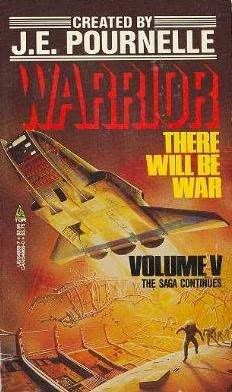
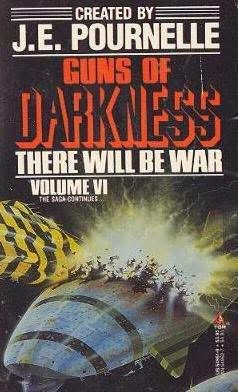
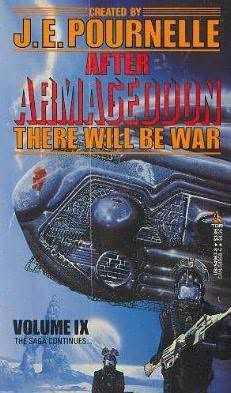
Over the past few weeks I've been reading some of Jerry Pournelle's There Will Be War book series, which was co-edited by John F. Carr. Filled with collected short stories, poetry, and political essays by various authors, the series served as a bully pulpit for Jerry and his conservative views. One common theme was his call for the construction of the original Strategic Defense Initiative (SDI), often referred to as "Star Wars" during the Reagan era. In almost every issue of There Will Be War, Jerry would demand a crash development program for anti-missile lasers, interceptor missiles, "brilliant pebbles" orbital weapons and such, so that the US would move away from Mutually Assured Destruction to an Assured Survival defense against Soviet nuclear weapons. To be frank, I never believed it would work for the main reason that so much of SDI would be easily thwarted with countermeasures, decoys, and other inexpensive, low-tech alternatives. And, of course, it never had to be because the Soviet Union imploded and ceased to be.

I am still skeptical when I read about the recent anti-missile test shots firing out of Kwajalein, and I surely don't want the US to spend billions of dollars for an anti-missile defense that may or may not work as advertised. Do we really need to spend mega-billions to counter a dubious threat from North Korea or Iran? Surely there's far better ways to spend those Pentagon dollars, perhaps in Afghanistan. And, I'm glad to report, my unit, the 22nd Bombardment Wing (Heavy) is no more. The huge B-52 D models are scrapped in the bone yard, while the 22nd carries on as an in-flight refueling unit. I'm glad because I know that somewhere in western Siberia, a Russian Long-Range Aviation unit was also deactivated, its Tupolev 95 Bear bombers chopped into segments as scrap, its doomsday weapons taken offline, stored, and hopefully, dismantled. I'm glad because I know, without a doubt, that both my wife's family in the East and my own family in the West are a little bit safer as a result.

Viktor Kuprin


P.S. While attending the DuckCon science fiction convention last year, I was present for a panel discussion about World Building in Fiction hosted by Alan Dean Foster, Roland J. Green, and other distinguished authors. During the event we were asked to pick one favorite book that we would choose to take if we were ever stranded on a desert island. My choice was The Mote In God's Eye, and I was doubly proud of my answer when I saw Alan Dean Foster smile and nod his head in understanding at my response. The late, great Robert A. Heinlein blurbed the cover of The Mote In God's Eye with these words: "Possibly the finest science fiction novel I have ever read." I wholeheartedly agree.

From the Wiki:

The Mote in God's Eye, by Larry Niven and Jerry Pournelle, is a science fiction novel that was first published in 1974. The story is set in the distant future of Pournelle's CoDominium universe, and charts the first contact between Mankind and an alien species. The title of the novel is a wordplay on Luke 6:41.

The book describes a complex alien civilization, the
Moties. The Moties are radically different (both physically and psychologically) from humanity in ways that become clearer over the course of the book. The human characters range from the typical hero-type in Captain Roderick Blaine to the much more ambiguous merchant prince and suspected traitor Horace Bury. Robert A. Heinlein, who gave the authors extensive, detailed advice on the novel, blurbed the story as "possibly the finest science fiction novel I have ever read".

The
novel is an example of hard science fiction in that close attention is paid to scientific detail. Larry Niven and Jerry Pournelle are noted for writing in this genre, and it is especially evident in this work with regard to the theoretical mechanics and physics of interplanetary travel. The book's Alderson Drive and Langston Field are literary inventions, but they are presented against a background of established science knowledge.

One interesting aspect of the novel — in comparison to other works of science fiction — is how the alien race's psychology is influenced by its physiology. Prior to this work, most aliens in science fiction would have a physiology radically different from human, but act and think in much the same way.

A sequel to The Mote in God's Eye, entitled
The Gripping Hand, was written by the same authors over twenty years later. It was published in the UK and other countries as The Moat Around Murcheson's Eye.


Technorati tags: , , , , , ,

Labels: , , , , ,

Thursday, February 28, 2008

Svatohor from Long Ago and Far Away

From 1989 to 1993, the Public Broadcasting Service (PBS) featured a delightful program of animated fairy tales, legends, and folkloric stories from around the world: Long Ago & Far Away. It was hosted by James Earl Jones. Yes, that James Earl Jones, famous as the voice of Darth Vader and for playing the role of Conan the Barbarian's arch-nemesis, Thulsa Doom. My daughter, Holly, and I loved the series, and always watched it every Sunday morning.

My favorite episode was this stop-motion animated Russian tale of Svatohor (Saint Mountain), a brave hunter who faced impossible tasks and the evil dragon-like creature Gorym Gorynet. Here, courtesy of YouTube, is that original feature in three parts.

I wish this series would be released as a DVD set. It would be a hot seller. Enjoy.


And here's a Snickers candybar commercial that parodies my favorite Russian fantasy movie, Ilya Muromets (The Sword and the Dragon). Though Zmey Gorynych, the three-headed dragon, doesn't actually appear in it, Ilya is there in all his Slavic glory.


Viktor Kuprin

Technorati tags: , , , , , ,

Labels: , , , , , ,

Tuesday, January 01, 2008

I Saw Ded Moroz on New Year's Eve!

Yes, I saw Dedushka Moroz, Grandfather Frost, on New Year's Eve! I had stepped out of my condo's back door to place a couple of bottles of bubbly on my patio to chill in the cold winter air. It had just gotten dark, and the edge of a cold front had arrived, soon to bring flurries of snow. I looked up and saw an amazing sight. The clouds had formed a perfect image of Ded Moroz, his big fluffy beard, nose and cheeks filling the eastern sky in perfect symmetry. And the timing was just about right because he had finished delivering gifts to all the boys and girls in Armenia, Russia, and other Eastern countries, and was by now headed West. There was no sign of Snegoruchka, the Snow Maiden. My own Snow Maiden waited for me inside: my wife, Irina. The magical visage of Ded Moroz lasted but a few minutes, then blew away as snow clouds began to cover south-central Indiana, and in the morning the snow would almost cover the ground. It was a magical experience, and a fitting end to the old year. Today we will celebrate with a New Year's feast, in the Armenian tradition of opening our home to guests on January 1st. I hope old Ded Moroz passed over your house, too. Happy New Year, S'Novim Godim!

Viktor Kuprin

Technorati tags: , , , , , , , ,

Labels: , , , , , , , ,

Monday, December 31, 2007

The Story of Ded Moroz, Grandfather Frost, the Russian Santa Claus


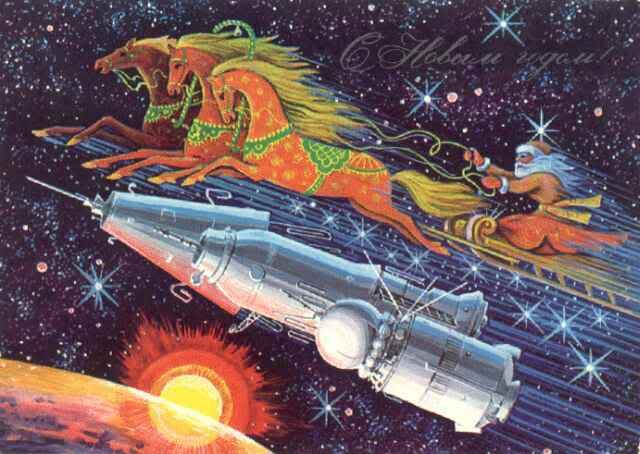
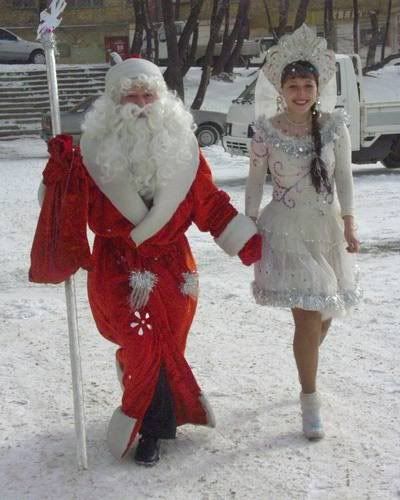
In Russia, Armenia, and other Eastern European countries, the holiday season heralds the arrival of Dedushka Moroz, “Grandfather Frost”, their version of Santa Claus. He looks a lot like the St. Nick that we know in the West, but he’s kind of different, too. He’s a bit thinner, and sometimes he wears blue coats, not just red ones. It is said that Joseph Stalin once ordered that Ded Moroz should always wear blue so as not to be confused with Santa Claus! Ded Moroz's home is deep in the forests “beyond Findlandia and Lapland”, and he rides in a troika sleigh pulled by three horses, not reindeer. The official residence of Ded Moroz in Russia is the town of Veliky Ustyug. The old fellow can get downright grumpy sometimes when children behave badly, but he brings presents to kids even if they’re good only right before New Year’s. That’s right, New Year's. In the East, they put up the yolka, the decorated evergreen tree for New Year’s since the more-quietly celebrated Orthodox Christmas falls on January 7, not December 25. But yolka trees often have a big red star on top, just like the ones on top of the Kremlin!

Another big difference between Ded Moroz and Santa Claus is that Grandfather Frost is a single guy. There’s no dowdy Mrs. Claus waiting for him back at the toy shop. Ded Moroz is often accompanied by Snegoruchka, the beautiful Snowmaiden who was made from snow by a lonely old Russian couple to live as their daughter. Sadly, she melts away every spring but returns each winter much to everyone’s delight. Legend has it that Snegoruchka is Ded Moroz’s granddaughter, but many people, me included, have doubts. She often wears some short-short white fur-lined dresses, and there may be some hanky-panky going on between her and old Ded Moroz. But then again, it gets pretty cold at night in Siberia!
S'Novim Godim, Happy New Year, to you all!

Viktor Kuprin

Technorati tags: , , , , , , , ,

Labels: , , , , , , , , ,

Monday, December 10, 2007

Outer Space Theater on Ray Gun Radio

You can hear my flash-fiction story Outer Space Theater on the December podcast of Ray Gun Radio, along with an interview of yours truly. The wonderful adaption of my short story was created by Don Abbott Studios, and playing the lead role is none other than "Commander Don" himself, Don Abbott, who hosted the Buck Rogers TV broadcasts that I watched as a boy. I was totally surprised when I received the radio-show style production, so Christmas came early for me. Thank you, Commander Don, for the wonderful present, and I hope you all enjoy hearing it.

Ray Gun Radio Episode 18 - Outer Space Theater Podcast

The holiday season is a long one at my house. For my wife, who lived in Moscow for many years, the big holiday is not December 25. New Year is the time when people in the Soviet Union celebrated the most. That's when they put up the yulka, the holiday tree, though more often than not it probably had a big red star on top instead of an angel.

Our Christmas and New Year wish this year is for the U.S. Embassy in Yerevan, Armenia, to grant a tourist visa to my lovely sister-in-law, so that she can visit us in America during the New Year holiday. It's tough to get such a visit approved, but we're hoping and praying that it will happen. And I hope everyone reading this has their holiday wishes come true, too.

Merry Christmas, and S'Novim Godim (Happy New Year!) to all!


Viktor Kuprin


Technorati tags: , , , , , , , ,

Labels: , , , , , , , ,

Tuesday, November 20, 2007

Ptushko's Ilya Muromets -
The Sword and The Dragon

In 1960 my great-aunt Ethie passed away, and my grandparents had the sad duty as executors of her estate. My grandmother, Ollie Marie George, and her sisters all had old fashioned names which you don't hear much anymore: Ethie, Novie, and Ollie, my "Mamaw". I was five years old, barely big enough to understand why we were going to Bedford, Indiana, where Aunt Ethie's home was located. Bedford and its surrounding towns are famous for their limestone quarries. The Empire State Building, The Pentagon, and many other famous buildings were built with Indiana limestone.

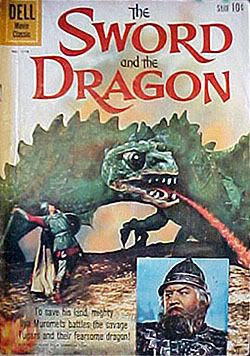
During one of the trips to Bedford, we stopped at a newly opened IGA "Foodliner" supermarket. I think my grandparents, so used to shopping at small general stores, were somewhat intimidated by the long, confusing rows of products and the bright fluorescent lights. At the front of the store was a comic book rack, a treasure before my eyes. My family used a sly but effective technique of allowing me to pick out one comic book during any trips to town, and encouraged me to choose carefully. In that way I was headed off from begging for whatever outlandish toy I might find. As a result, I began reading at an early age, and as time went by, I accumulated a substantial comic book collection. And I still have many of those comics to this day.

As I scanned the comic book covers, one immediately caught my eye: A huge, hideous fire-breathing dragon and a hefty guy in armor getting ready to have at it! The issue that I chose that fine day was the comic book version of the film The Sword and The Dragon. Many, many years later I would learn that the movie was Russian, originally titled Ilya Muromets, directed by the Soviet Ray Harryhausen, Alexandr Ptushko.

Recently I had the pleasure of seeing the original film on DVD, beautifully restored by Russia's Rusico film company, along with other Ptushko classics such as Ruslan and Ludmilla, Sadko, and The Tale of Tsar Sultan. I'm still waiting for Sampo, known in the West as The Day The Earth Froze, based on the Finnish Kalevala saga.

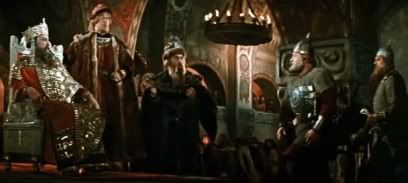
Released in the Soviet Union in 1956, Ilya Muromets is based on a well-known Russian folktale about a paralyzed hero (Ilya) who regains his strength to do battle against the invading Tugar tribe of vicious Tartars. He encounters a hurricane-breath demon (Nightingale), treacherous boyars, and, in the grand finale, the terrible three-headed dragon, Gorynich, which may have inspired Ishiro Honda and Tomoyuki Tanaka when they later introduced King Ghidorah in their Godzilla films.


Ilya Muromets is an amazing film, my favorite of all Ptushko's work. He must have had the entire Red Army in use as extras during its production because its publicity information claims "A Cast of 106,000! 11,000 Horses!" The scenes of the massive Tugar army on the move are astounding. It is noteworthy too as being the first USSR film made in "SovietScope", actually Dyaliscope, the French version of Cinemascope, and it was the first Soviet film to have a stereo soundtrack.

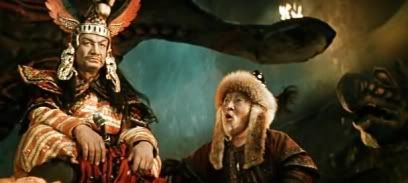
Some of the best scenes in the movie come from the villains, the Tugars, especially their chief, Tsar Talin. Played by Uzbekistan's veteran stage and film actor Shukur Burkhanov, the ruthless Talin grins and leers as he gleefully declares, "I'm going to attack ... KIEV!" Burkhanov started acting in the 1920's but had to leave his family to be able to become an actor. The strict Islamic law practiced in his home region forbid one person from imitating another. Trained at the Moscow Art Theater and in the Stanislavsky School of Acting, his delightful performance as the evil Tartar in Ilya Muromets is in total contrast to the stodgy, serious Russian hero, Ilya, played by Boris Andreyev.


Epic films such as Ilya Muromets can now only be made via computer graphics. And I suspect it would have been impossible to finance such a movie in the West even during the 1950s. Only the cost-blind Soviet system could have produced such a spectacle. Let's hope that Rusico will continue to restore and release more classic films. Spasiba Rusico!


Gorynich The Dragon Attacks Kiev


Technorati tags: , , , , , ,

Labels: , , , ,

Friday, November 09, 2007

Used Starships and Soviet Animation: Bradbury's There Will Come Soft Rains

Here's my "back-cover blurb" for my NaNoWriMo story, which takes place in the Kosmosflot universe:


Photon_Ship

Would you buy a used starship from this guy? Max Kreminov believed he could sell a “previously owned” spacecraft to at least one of the thousands of space travelers, aliens, and robots attending the Valeda World Fair and Interstellar Expo. But he had no idea that he would travel across a quarter of the galaxy into hostile space to close the deal. Max has to wonder: What must a guy do to make an honest ruble in this galaxy?

*************************************

My NaNoWriMo ID is Cosmonaut. Here's an excerpt from the first chapter:

Valeda Star System
High Orbit
20 Aug 2563 07:35 UTC

Starship orbital paths traced and overlayed as colored lines across the cockpit's main televisor screen. Max Kreminov marveled that Valeda's traffic control could handle the thousands of arrivals and landing requests. A couple of ship icons racing around Valeda's globe showed red, declared inflight emergencies. He wondered if they were genuine or just reckless attempts by the ships' owners to get a better spot in the approach queue. He hoped not. His own Praznik Alfa starship had one more orbit to go, then it and the other ships in his small convoy would get their turn.

Max toggled the display from NAV-PLAN to TELEPHOT-20X, trying to get a glimpse of his Arbus and Tikva freighter ships that would land first. He could barely make out the fat Arbus, the "Watermelon", in the far distance. On top of the freighter's hull was the white disk of the IIS Recon ship, mated to the larger ship piggyback-style. The Tikva, the "Pumpkin" was out of visual range, so Max could only hope that the three modular cutters mounted on the top of its hull would stay secured during the long, slow descent down to surface, to the World's Fair landing zone.

And a beautiful world it was, Max thought as he sipped from a drink bulb of strong black tea. Valeda's green globe filled the televisor. The planet was one of the Orion Arm's rare garden worlds, rich with oxygen, water, and comfortable gravity, too. Comfortable for humans, anyway. The citizens of Valeda had become extremely prosperous as a result of their world's natural bounty. And to celebrate and grow their economic success, the Valedians were spending billions of rubles for their first World's Fair. With that in mind, Max hoped he would be leaving Valeda a richer man. After all, among the hundreds of thousands of humans, hundreds of robots, and probably a few Tsoor aliens attending the fair, surely a wealthy few would want to buy some good, used starships.

A robotic voice spoke. "Valeda Approach to flight SU 894. You are good for entry and descent on your next orbit, GCA channel 904, repeat, GCA channel 904. Lock and squawk to acknowledge."

At last! Max keyed the response as quickly as his fingers could tap the smooth keys set in the stainless steel flight console. Unlike most CIS starships, there were no turquoise-blue control panels in his Alfa. Hundreds of years in the past, during the years of the USSR, psychologists and flight-control experts had determined that bluish tones were somehow soothing and comforting to flight crews. Their usage had continued into the designs of spacecraft built by the Commonwealth of Independent Stars' worlds. Max's Alfa originally had those bird-egg colored consoles in its cockpit even though it had been built far beyond CIS zones. Max replaced them, added extra plush pilot's chairs, and, as time went by, spent extra rubles for even more customization. After all, it was where he lived even when he and his ensemble of used starships were grounded on some planet or docked at a space station. A man should make some effort for comfort in his home, he thought, even when travelling between the stars.

The comm softly chimed. The televisor morphed into the image of young Edvin in the first ship, the Tikva. "Mister Kreminov, I got clearance for descent on the next orbit."

"Me, too. Let me patch in Apo." Max set the ship-to-ship laser comm into a three-way link. The long, droopy face of his systems engineer appeared on screen alongside Edvin's comm window.

"You ready to drop, Apo?" said Max.

"Yes, and about bloody time," the old tech replied. "I want to get out of this carousel before something goes wrong. Do you see how many ships are spinning around this rock?"


*************************************

Please send encouragement and threats for me to get this 50,000-word effort done by the end of the month!


Soviet Animation - Ray Bradbury's There Will Come Soft Rains

It's always a real ego-boost for a writer when a reader says, "Your story reminded me of ..." and names some wonderful author in comparison. The first time this happened to me, the compliment came from a pair of 11-year-old twin brothers, Noan and Ethan Sandweiss, when they said some of my work reminded them of Ray Bradbury's The Martian Chronicles. I could only smile, thank them, and pray that I might one day attain a small touch of that great author's talent. And after writing these words, I fully expect someone to leave me a comment saying, "I have read Ray Bradbury. Ray Bradbury is my favorite author. You are no Ray Bradbury," and, if that happens, it would be deserved.

While searching the Internet for animated science-fiction features produced in the Soviet Union, I discovered this eerie Uzbekfilm Studio's adaptation of Ray Bradbury's There Will Come Soft Rains. Its style reminds me very much of one of my favorite animated SF films, Rene Laloux's Fantastic Planet. Since I really should get back to writing for NaNoWriMo, without further comment, here it is:


There Will Come Soft Rains


Technorati tags: , , , , , , , ,

Labels: , , , , ,

Wednesday, November 07, 2007

Soviet Animation - Fantadrom 2 and Nu Pogodi! - You Just Wait! I'll Get You!

What's an alien to do when it needs to borrow a pinch of salt?

The answer is in Fantadrom episode 2, a classic Soviet-era science-fiction animation from the early 80s. The first episode is also viewable in my earlier blog posting.

You might notice that in the film text is sometimes displayed in Russian Cyrillic and in Latin script. The English-like letters are Latvian; Fantadrom was created in a Riga animation studio. Nonetheless, Russian was the language most often spoken in public and used for business in the USSR, and spoken dialogue is always Russian.

The Internet has certainly promoted the study of English in Armenia, where I used to live, and in other former-Soviet countries, but Russian is still taught in Armenian schools, and no responsible parent would ever allow their children not to learn it.

Like so many Soviet-era cartoons, Fantadrom is playful, silly, and sometimes very surreal. Many Soviet animators were greatly influenced by the Beatles' animated film The Yellow Submarine as well as the psychedelic artwork of Peter Max.


Fantadrom 2


Nu Pogodi!

And here is a sample of the much more rough-and-tumble Nu Pogodi (You Just Wait, I'll Get You!), with the scruffy, cigarette-smoking wolf always after the cute, innocent hare. Like all good villains, the wolf is by far more interesting than his victim, and you can get some good glimpses of daily Soviet life from these cartoons, like the electric trolley-buses. A ride on one still costs 5 cents in Yerevan, Armenia! And there's the huge escalators leading to the metro, the subway. There are no "undergrounds" here in Indiana, and it was so convenient and fun to ride them in Yerevan. The price of a subway token: yes, 5 cents!


Notice, too, the scene where the wolf shows his empty pockets to the passing militsia cops, to avoid being shaken down for a bribe. Americans have no concept of how corrupt law-enforcement officers demand money from innocent citizens, but it happens every day in the former USSR.

And be warned: The lalala-lala Nu Pogodi main theme song will stick in your brain for the rest of the day. I caught myself singing it in the shower this morning!


Do S'Vadaniya,

Viktor Kuprin

Technorati tags: , , , , , , , , , , ,

Labels: , , , , ,

Monday, November 05, 2007

Violence, Kids, and Soviet Animation

From today's news:

Screen violence tied to boys' aggression: study

By Andrew Stern

CHICAGO (Reuters) - Boys aged 2 to 5 who viewed an hour of on-screen violence a day increased their chances of being overly aggressive later in childhood, but the association was not seen in girls, researchers said on Monday.

"This new study provides further evidence of how important and powerful television and media are as young children develop," study author Dr. Dimitri Christakis of Seattle Children's Hospital Research Institute said.

"Of 184 boys (in the study), 25 of them had serious problems with aggression and for each hour on average per day they had watched violent TV, they were three times more likely to be in that group" than those who did not watch violent programming, Christakis said in a telephone interview.


While living in Armenia, I got to see many Soviet-era animated programs, some of excellent quality. This was a direct result of the communist-era laws that compelled film and television studios to devote a percentage of their production for children's programming. One noticeable difference between their cartoons and those produced in the West was the lower level of violence. Sure, the Russians loved their Nu Pogodi (I"ll Get You) antics of the Wolf and Hare, the USSR equivalent of Tom and Jerry, but most of the made-in-the-USSR toons were gentler and, perhaps, a bit kinder than the cartoons I watched growing up in the USA.

And because I watched and loved seeing Popeye knock the bejeesus out of Bluto on a daily basis, not to mention the Three Stooges every Saturday morning, I have mixed feelings about the Reuters story above. I like to think those shows didn't warp my young mind and, so far, I've never had the urge to actually go postal and do anyone real harm, except perhaps sometimes in my strange-but-harmless imagination.


I once read that the Japanese consider Tom and Jerry style cartoon violence to be much more disturbing and harmful to children because it is so fake. If you've ever seen Japanese anime, you know that when a person gets shot, there are consequences. It is shown to be painful, there is blood and injury that doesn't disappear in the next scene. Not so when Jerry whacks Tom with an anvil or frying pan. Tom's head pops back into normal shape and the chase continues.

My five-year-old son, Ron Armen, loves to watch the Power Rangers and Transformers, though his watching time is strictly rationed by Irina, his mom, more for consideration of his eyesight than the programs' content. I know he acts out the martial arts moves that his favorite TV characters do on screen, but he doesn't use those moves to whup the five-year-old neighbor kid down the block. I am very skeptical, too, of studies like Dr. Christakis has done because I know that statistics can be presented to emphasize a politically-correct agenda and thus please the sponsoring parties involved. I think that out of nearly 200 American boys, for 25 of them to have problems with violent behavior is not that surprising, sad but true. It's just hard for me to believe that most of the blame can be directed towards television programs.

And back in Armenia, kids now get to watch imported Tom and Jerry cartoons, including all the flying anvils, crushing boulders, and face-flattening frying pans. Their lack of spoken dialogue makes them great exports to non-English speaking countries like the former USSR.

Here's a wonderful example of some Soviet-era animation, and it's a science-fiction piece, too. I love the Cosmic Cat!

Do S'Vadaniya,

Captain Kosmos


Fantadrom One


Technorati tags: ,, , , , , , , ,

Labels: , , , , , , , , , , ,