Used Starships and Soviet Animation: Bradbury's There Will Come Soft Rains
Here's my "back-cover blurb" for my NaNoWriMo story, which takes place in the Kosmosflot universe:
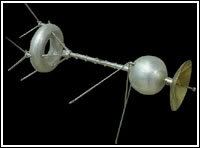
Would you buy a used starship from this guy? Max Kreminov believed he could sell a “previously owned” spacecraft to at least one of the thousands of space travelers, aliens, and robots attending the Valeda World Fair and Interstellar Expo. But he had no idea that he would travel across a quarter of the galaxy into hostile space to close the deal. Max has to wonder: What must a guy do to make an honest ruble in this galaxy?
*************************************
My NaNoWriMo ID is Cosmonaut. Here's an excerpt from the first chapter:
Valeda Star System
High Orbit
20 Aug 2563 07:35 UTC
Starship orbital paths traced and overlayed as colored lines across the cockpit's main televisor screen. Max Kreminov marveled that Valeda's traffic control could handle the thousands of arrivals and landing requests. A couple of ship icons racing around Valeda's globe showed red, declared inflight emergencies. He wondered if they were genuine or just reckless attempts by the ships' owners to get a better spot in the approach queue. He hoped not. His own Praznik Alfa starship had one more orbit to go, then it and the other ships in his small convoy would get their turn.
Max toggled the display from NAV-PLAN to TELEPHOT-20X, trying to get a glimpse of his Arbus and Tikva freighter ships that would land first. He could barely make out the fat Arbus, the "Watermelon", in the far distance. On top of the freighter's hull was the white disk of the IIS Recon ship, mated to the larger ship piggyback-style. The Tikva, the "Pumpkin" was out of visual range, so Max could only hope that the three modular cutters mounted on the top of its hull would stay secured during the long, slow descent down to surface, to the World's Fair landing zone.
And a beautiful world it was, Max thought as he sipped from a drink bulb of strong black tea. Valeda's green globe filled the televisor. The planet was one of the Orion Arm's rare garden worlds, rich with oxygen, water, and comfortable gravity, too. Comfortable for humans, anyway. The citizens of Valeda had become extremely prosperous as a result of their world's natural bounty. And to celebrate and grow their economic success, the Valedians were spending billions of rubles for their first World's Fair. With that in mind, Max hoped he would be leaving Valeda a richer man. After all, among the hundreds of thousands of humans, hundreds of robots, and probably a few Tsoor aliens attending the fair, surely a wealthy few would want to buy some good, used starships.
A robotic voice spoke. "Valeda Approach to flight SU 894. You are good for entry and descent on your next orbit, GCA channel 904, repeat, GCA channel 904. Lock and squawk to acknowledge."
At last! Max keyed the response as quickly as his fingers could tap the smooth keys set in the stainless steel flight console. Unlike most CIS starships, there were no turquoise-blue control panels in his Alfa. Hundreds of years in the past, during the years of the USSR, psychologists and flight-control experts had determined that bluish tones were somehow soothing and comforting to flight crews. Their usage had continued into the designs of spacecraft built by the Commonwealth of Independent Stars' worlds. Max's Alfa originally had those bird-egg colored consoles in its cockpit even though it had been built far beyond CIS zones. Max replaced them, added extra plush pilot's chairs, and, as time went by, spent extra rubles for even more customization. After all, it was where he lived even when he and his ensemble of used starships were grounded on some planet or docked at a space station. A man should make some effort for comfort in his home, he thought, even when travelling between the stars.
The comm softly chimed. The televisor morphed into the image of young Edvin in the first ship, the Tikva. "Mister Kreminov, I got clearance for descent on the next orbit."
"Me, too. Let me patch in Apo." Max set the ship-to-ship laser comm into a three-way link. The long, droopy face of his systems engineer appeared on screen alongside Edvin's comm window.
"You ready to drop, Apo?" said Max.
"Yes, and about bloody time," the old tech replied. "I want to get out of this carousel before something goes wrong. Do you see how many ships are spinning around this rock?"
*************************************
Please send encouragement and threats for me to get this 50,000-word effort done by the end of the month!
Soviet Animation - Ray Bradbury's There Will Come Soft Rains
It's always a real ego-boost for a writer when a reader says, "Your story reminded me of ..." and names some wonderful author in comparison. The first time this happened to me, the compliment came from a pair of 11-year-old twin brothers, Noan and Ethan Sandweiss, when they said some of my work reminded them of Ray Bradbury's The Martian Chronicles. I could only smile, thank them, and pray that I might one day attain a small touch of that great author's talent. And after writing these words, I fully expect someone to leave me a comment saying, "I have read Ray Bradbury. Ray Bradbury is my favorite author. You are no Ray Bradbury," and, if that happens, it would be deserved.
While searching the Internet for animated science-fiction features produced in the Soviet Union, I discovered this eerie Uzbekfilm Studio's adaptation of Ray Bradbury's There Will Come Soft Rains. Its style reminds me very much of one of my favorite animated SF films, Rene Laloux's Fantastic Planet. Since I really should get back to writing for NaNoWriMo, without further comment, here it is:
There Will Come Soft Rains
Technorati tags: science fiction, movies, films, Russia, Soviet Union, animation, cartoons, NaNoWriMo, Ray Bradbury
Labels: animation, cartoons, NaNoWriMo, sci-fi, science-fiction, Soviet Union
posted by Captain Kosmos @ 2:23 PM
2 comments