Saturday, September 27, 2008

Soldier - The Outer Limits
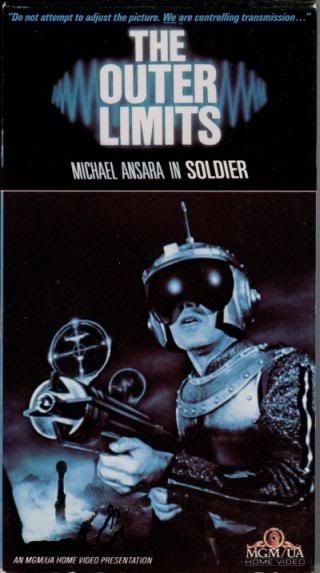

While clearing out some of my old VHS tapes, I ran across my favorite episode from the original Outer Limits TV series: Soldier. I watched this outstanding hour-long show when it was originally broadcast on September 19, 1964. It is unforgettable. Written by Harlan Ellison, the tale begins in the far future when the Earth is a desolate, war-torn planet. A soldier in battle helmet, armed with a distintegrator rifle, pauses for a smoke break. But not for long. His helmet starts issuing audio commands: "Find the Enemy! Attack! Kill!" Not far away is another soldier-of-the-future in similar armor, and in minutes the two adversaries are charging toward each other. But as they collide, two artillery-like energy beams cross at their exact location, throwing both troopers into a time warp that transports them back to 1964. The first soldier reappears in a back alley of some large American metropolitan area, and he soon draws attention from startled passersby. Then the police arrive and start to advance towards him. He raises his blaster rifle and vaporizes their police car with a single shot.

Finally taken prisoner and sequestered in a government holding facility, the rest of the tale shows how the puzzled officials interrogate and, finally, correctly identify just what the dangerous visitor is: the ultimate infantry soldier.

The second soldier remains trapped in the time-warp flux, unable to free himself until much later in the story. But when he does, the mission imperative remains: "Find the Enemy! Attack! Kill!"

Michael Ansara played the role of the first soldier from the future, Qarlo Cobregnny, and was well known to TV audiences in 1964 from the western TV series Broken Arrow, in which he starred as the stoic Apache Indian chief Cochise.

Soldier is filled with wonderful science-fiction details like self-igniting cigarettes, reports that Qarlo's disintegrator rifle continues to function even when parts are removed from it (advanced quantum physics?), and Qarlo attempting to verbally report to a pet cat because felines are used as recon scouts on the battlefields of the future. It is a one of the earliest and finest examples of military science fiction to appear on TV, in glorious black-and-white.

A bit of trivia: Qarlo's battle helmet would reappear 14 years later, worn by Robin Williams in the goofy 1978 TV comedy series Mork & Mindy! Fact is, in 1964 I had a toy helmet similar to Qarlo's: the now-rare Monkey Division visored helmet!

D'os Vadanya,

VIKTOR KUPRIN


Technorati tags: , , , , , , ,

Labels: , , , ,

Wednesday, July 16, 2008

Recovery, the Beluga submarine, and Voyage to the Deep

I survived my visit to the surgeon last Friday, and I’m happy to report that I’m feeling better every day, even quasi-human some of the time. My dear wifey and son have been most attentive to my needs during my recovery, and my dear cohorts at work have (so far) left me alone to convalesce, bless them all.

One of the few things I can do while flat on my back is, thank goodness, read. Before I went on medical leave I was able to stock up on some special-request books from the Indiana University library, including the following:

Cry of the Deep: The Submarine Disaster That Riveted the World and Put the New Russia to the Ultimate Test, by Ramsey Flynn – A gripping account of the loss of the submarine Kursk.

Rising Tide: The Untold Story of the Russian Submarines That Fought the Cold War, by Gary E. Weir and Walter J. Boyne.

Hostile Waters, by Captain Peter Huchthausen, USN (ret).; Captain First Rank Igor Kurdin, Russian Navy; and R. Alan White – An account of the loss of the Russian submarine K-219 during the height of the Cold War.

Cold War Submarines: The Design and Construction of U.S. and Soviet Submarines, by Norman Polmar and Kenneth J. Moore.

As you can tell, I was in an undersea mood having just read William H. Keith’s submarine warfare-in-the-future novel Sharuq. And even thought I’m an Air Force veteran, I’ve always been interested in ships and submarines. 20,000 Leagues Under the Sea by Jules Verne was probably the first true science fiction book that I ever laid eyes on as a boy, and Captain Nemo was certainly my first and still favorite anti-hero. Adding to my oceanic inspirations was the fact that my father was a Navy man, a torpedoman’s mate, during the Cold War. Dad served aboard the USS Fulton, the famous submarine tender that supported some of the most historic submarines in Navy history, including the Nautilus, the Skipjack, and the Triton. I spent many an hour browsing through my dad’s Bluejacket manual, gazing at photos of those amazing subs. And now my six-year-old son is doing the same, looking through the great pictures in the Cold War Submarines volume, even sketching some drawings for his laid-up dad.

I almost dropped the hefty Cold War Submarines book when I came upon the photo and schematic of the Soviet’s Project 1710 – NATO Code name Beluga submarine. Commissioned in 1987 as a research platform for streamline hull design, the Beluga is the spitting image of a fictional submarine called the Proteus, from Dell Comic’s early 1960’s four-issue mini-series Voyage to the Deep. Drawn by one of my favorite “silver age” comic artists, Sam Glanzman, this submarine/SF series was undoubtedly an unofficial inspiration from Irwin Allen’s Voyage to the Bottom of the Sea motion picture that later became a television series on the ABC network. Glanzman also drew another of my favorite early-1960s Dell comics, Kona: Monarch of Monster Isle, a great Lost World/SF series filled with dinosaurs and other overgrown beasties.

In the Voyage to the Deep series, the Proteus was the first American submarine able to dynamically “change its mass” via some amazing new technology. Glanzman showed the sub actually changing its length and weight at critical times during its voyages. There were vague references to “The Enemy”, i.e. the Soviets, and the plots were very much like those that would later be seen on Irwin Allen’s Voyage to the Bottom of the Sea TV series.

But you have to give Sam Glanzman some credit. He depicted the ultra-modern submarine’s design in perfect form … 25 years before it was actually built! Unfortunately for the Soviet Navy, they were not able to dynamically alter the Beluga sub’s mass during its voyages!

Best wishes,

Viktor Kuprin


Technorati tags: , , , , , , , ,

Labels: , , , ,

Friday, May 30, 2008

Marcon, William H. Keith, and now on DVD: The Invaders - Season 1

The Marcon SF convention in Columbus, Ohio, was great fun last weekend, though everyone was saddened by the unexpected death of author guest-of-honor Robert Asprin just before the event. Though I was not a reader of his work, I join everyone who mourn his passing. A lesser disappointment for my six-year-old son was the lack of a swimming pool at the downtown Hyatt hotel, but otherwise it was an excellent con.

William H. Keith - Author and Artist

The highlight of the convention for me was getting to meet author and artist William H. Keith Jr., whose work I have followed more years than I care to admit. Bill has had over 80 books published, plus short stories, role-playing games, source books, and lots of fantastic SF art for the Traveller SF role-playing game. Along with his late brother, Andrew Keith, Bill was responsible for much of the "look" of Traveller, and his spacecraft designs are some of my favorites. I was very happy to see some dazzling prints of Bill's graphics at the Marcon art show, and I managed to come home with a great piece by Bill depicting a "Retro Launch" rocket boosting into space. Fact is, I'm in the middle of reading Bill's latest military SF novel, Star Strike, done under the penname of Ian Douglas. His military techno-thrillers (Silent Service; Seals, The Warrior Breed) are done under the H. Jay Riker moniker. Bill is scheduled to appear at Pittsburgh's Confluence con, July 25-27, and if the planetary orbits line up just right, I may make it there, too.

The Invaders - Season 1

The Invaders, alien beings from a dying planet. Their destination: the Earth. Their purpose: to make it their world. David Vincent has seen them. For him, it began one lost night on a lonely country road, looking for a shortcut that he never found. It began with a closed deserted diner, and a man too long without sleep to continue his journey. It began with the landing of a craft from another galaxy. Now David Vincent knows that the Invaders are here, that they have taken human form. Somehow he must convince a disbelieving world that the nightmare has already begun.

That was how each episode of the 1967-68 SF-horror series The Invaders started, and I'm very happy to report that the first season of that classic Quinn-Martin production was released on DVD this week. Dominic Frontiere's eerie soundtrack still gives me chills. He also scored the original opening and closing themes for The Outer Limits, another sixties SF-horror classic. The Invaders featured ruthless aliens (disguised as humans), great hardware (flying saucers, disintegrator pistols, and the "cerebral hemorrhage" disc weapon), suspenseful stories, and fine actors. I remember watching the episode where guest star Michael Rennie, from The Day The Earth Stood Still, played the role of an important alien leader, a real touch of class by the program's casting director. And though subtle compared to modern standards, I remember many scenes involving the disguised aliens that were very frightening. David Vincent might notice the tell-tale imperfect pinky finger of an alien-in-disguise, the eerie alien theme music would play, and the expressionless alien would make eye contact with Vincent, look directly into the camera. Scenes like that scared the bejeezus out of me more than once when I was a kid, I shamelessly admit. Roy Thinnes, the show's star, was often panned by the critics, but I was always impressed by his serious-as-hell, on-the-edge performance as one man unintentionally made aware of a covert invasion by cold, murderous aliens. Bravo to Paramount for releasing The Invaders on DVD. It's certainly one of the best American SF television series made in the sixties.

D'os Vadanya,

Viktor Kuprin

Technorati tags: , , , , , , , , , ,

Labels: , , , , , , , , , ,

Tuesday, October 09, 2007

In Search of Buck Rogers and Commander Don

It was a drizzly, dark day, the kind that all eight-year-old boys detest. Stuck indoors and grounded by the inclement weather that Saturday morning in 1964, I started searching the Indianapolis Star’s TV schedule, first to check what our local horror host, Sammy Terry, would be featuring on his late-night scary movie.

Remember, this was the television era when nearly all stations had locally-produced and hosted programs. WFBM Channel 6 had Harlow Hickenlooper (Hal Fryar) and cowboy-musician Curley Myers introducing Three Stooges films. WTTV Channel 4 offered the ghoulish Sammy Terry on Nightmare Theater. For the younger kids, there was Popeye and Janie (Jane Hodge), and a few years later Cowboy Bob (Bob Glaze) hosted the noon-time cartoon show Chuckwagon Theater.

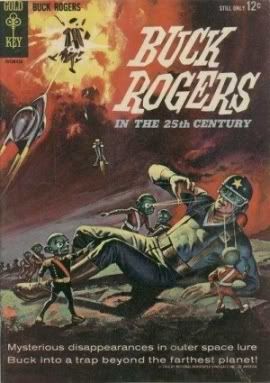
As I scanned the Saturday schedule, I spotted something new: Buck Rogers on Channel 8. This immediately caught my interest. I had heard my father tell about the old Buck Rogers radio programs, and I had even seen a few reprints from the 1930s Buck Rogers newspaper comic strip in books at my local library. And my treasured comic book collection included Gold Key's 1964 single-issue Buck Rogers edition, too. I checked the time, and I was in luck. Buck Rogers would start in a few minutes!

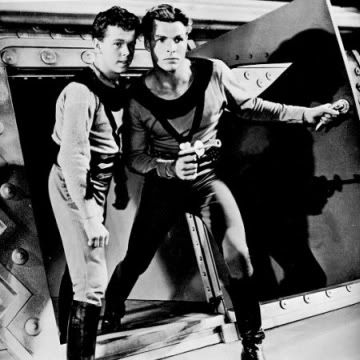
After a first glimpse of that classic 1940 serial, I was hooked. There were rocket ships that looked like Civil War ironclads. Buck (Buster Crabbe) and his 25th Century crew used anti-gravity belts instead of parachutes. There was even a teleportation chamber that Buck used to get around the Hidden City rocket base, instead of an elevator.

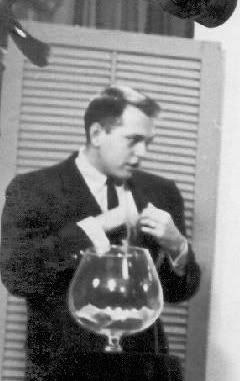
And there was a show host, Commander Don, dressed in a flight suit coverall, sitting at a space-age desk as he commented on Buck’s perils and adventures, as well as making an occasional plug for the show’s sponsor. I recognized Commander Don as the host of another popular program, the Booby-Trap game show also shown on Channel 8. More on that later.

Now, to an eight-year-old, Buck Rogers was heady stuff. You must remember, too, that in 1964, science-fiction TV programs were scarce. Channel 4 had started showing the Space Angel cartoon series, wonderfully drawn by the great artist Alex Toth, and there was the occasional science-fiction movie on TV or at the local theater. So finding Commander Don and Buck Rogers as a weekly show was a great event for a kid like me.

Each and every Saturday I followed Buck’s adventures and travels across the solar system as he battled the evil Killer Kane. By summer’s end the serial concluded, and I was in Space-Age heaven when I saw that starting in autumn there would be a Flash Gordon program in the same time slot on Saturday morning.

That fall, as I watched the first episode of Flash Gordon battling the evil Emperor Ming the Merciless (played by the great character actor Charles Middleton) on the dark, mysterious Planet Mongo, a commercial break started. I realized then that there was no host, no commentary. Commander Don was gone. And I missed him. Sure, I was aware that Commander Don was a TV host working in a studio somewhere in downtown Indianapolis, and that he wasn’t really some auxiliary space officer assigned to the Buck Rogers TV show. Nonetheless, I appreciated that the show had a real, live host, in uniform, no less. To my young eyes, Commander Don’s presence had somehow added a degree of Space Age authority, a measure of legitimacy to the show. And as time passed and the years went by, I sometimes wondered what had become of Commander Don.


Now, time warp with me forty years into the future, from 1965 to the year 2005. While surfing the ‘Net I discovered a charming web site about early TV programming in Indiana called What Columbus Watched On Television In Shades Of Black And White, created by David Sechrest. There was no mention of the Buck Rogers/Flash Gordon shows I had loved so much, but I was pleased to see that the Booby-Trap game show was remembered. But then I saw the passage that said: “Sorry, but I can't remember who the host of this show was.”

This really bothered me. I made a pledge to find out who had hosted my beloved Buck Rogers and Booby-Trap TV shows, and I started searching. Unfortunately, as I soon discovered, there are scant records of those early days of locally-produced television programs. Commercial broadcasters have no business incentive to retain historical records. Many shows like WISH-TV's Buck Rogers and Booby-Trap were broadcast live in front of a studio audience, and if videotape was used, it was recycled, erased and re-used week after week. Very few locally-produced programs from that era still exist in any complete form.

I finally got a lead when I happened upon the When Movies Were Movies web site, created by former WISH-TV producer Dave Smith, who had hosted a popular movie series of the same name as the site. Dave remembered that the host of Booby-Trap was Don Abbott, who had also done radio work in Indianapolis during the early 1960s, but Dave had no recollection of the Buck Rogers series shown on Saturday mornings. He said he could verify this by contacting Don, now a producer of television programming living in Florida.

Emails were exchanged and, as I so fondly remembered, Don confirmed that he had been the one who donned an orange coverall and introduced the Buster Crabbe serials. I think, perhaps, Don was surprised and maybe a little touched that someone remembered his work in Indiana those many years ago.

Inspiration comes from many sources, and I was inspired to write a short story, a flash fiction, called Outer Space Theater that was actually a tribute to Commander Don. I submitted the story and it won a Special Mention for Flash Fiction at Ray Gun Revival, one of the best space opera ezines you can find online. I wanted to share my minor success, so I emailed a copy of the story to Commander Don, who received it with gracious praise for my efforts. In fact, Don suggested that we meet the next time he visited Indiana.

A few weeks later, I received an email saying that Don was headed to the Hoosier state to attend a wedding, and it would be a good opportunity to get together. We picked Franklin, Indiana, as our rendezvous point, so I began to prepare.

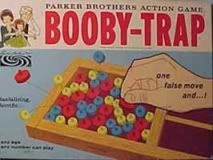
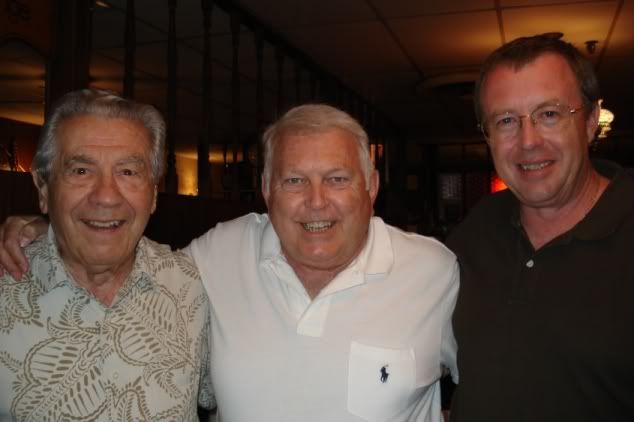
And what a meeting! Don arrived with his son-in-law, Greg, and we started sharing the stories of our lives along with many happy memories of the TV shows Don had hosted. I learned that day that Don had tried to get the Parker Brothers game company to franchise his successful Booby-Trap game show. The execs turned down the franchise sponsorship, but instead offered to buy the rights to manufacture the Booby-Trap game itself. I don’t know about elsewhere in the country, but every kid I knew had the Booby-Trap game. Its little round, wooden game pieces filled toy boxes and covered living room floors all across Indiana. I can’t remember how many times my finger got snapped by the game’s spring bar. That was half the fun, of course. Don’s deal with Parker Brothers earned him enough profits to later start his television productions in Florida.

I got an additional surprise that afternoon when we were joined by another Hoosier TV personality who is both well-remembered and dearly loved by his fans of all ages: Hal Fryar, known better as Harlow Hickenlooper of WFBM Channel 6’s long-running Three Stooges Show. Both Don and Hal are members of the Indiana Broadcast Pioneers, and it was just a great pleasure to hear their accounts, anecdotes, and lots and lots of jokes. Both Don and Hal are true entertainers, and they kept me and Greg laughing. My time with them passed all too quickly.

As we said our goodbyes, I presented Don with a copy of the recent Criterion Collection DVD release of Robinson Crusoe on Mars, which, strangely enough, has a connection with both Don and Hal. In 1965 Hal and seven other Three Stooges show hosts participated in the making of The Outlaws Is Coming movie, which starred Moe, Larry, and Curly Joe. Hal played outlaw Johnny Ringo, but the connection was that the leading man was played by a pre-Batman Adam West, who also had a supporting role in Robinson Crusoe on Mars! RCOM was released in 1964, just a few months before Commander Don started hosting the Buck Rogers shows.

But, stranger still, is a detail in the Outer Space Theater story that I wrote. In it, the Commander Don character makes use of a piece of high-tech gear disguised as a Franklin half dollar which he keeps in his pocket until a crucial part of the story. Here’s where it gets weird: Don told me that he has always carried a lucky silver dollar in his pocket, even showed it to me during our meeting. I had no idea, no knowledge of this when I wrote the story. Coincidence? ESP? Who can say? The universe is a wonderfully strange place, isn’t it?


Harlow Hickenlooper, Commander Don, and Viktor Kuprin


D'os Vadanya,

Captain Kosmos


Technorati tags: , , , , , , , ,

Labels: , , , , ,